Monday, December 2, 2013

I was a weird kid...

Anthropomorphism- the attribution of human characteristics or behavior to a god, animal, or object.
I believe everyone is an anthropomorphist starting from a very young age. By the time we can talk we are conversing with teddy bears, and tucking our Barbie in at night. None of our toys are alive and yet we believe them to be so. You can chalk this up to the imagination but I chose to associate it with anthropomorphism. I found it very hard to get rid of stuffed animals and dolls and I still have several –in my attic granted- because they were too real to me to give away. It is not just an attachment; you feel attached to things. For me these toys have personalities. Starting at a very young age I believed all of my dolls and toys to be alive in some way. Maybe not even with the personality I was assigning them when I played but I believed they had a consciousness. I guess I was a weird kid because it was not just my toys. It was the rocks on the playground the tire swing the trees. All of these things were very alive and aware to me. I thought everyone felt that way. Boy was I surprised when I expressed my feelings and people were confused.

Toy Story 3 was one of the best movies ever am I right

Good thing anthropomorphizing is normal in writing. Things like swords and items of power in books like Eragon tend to be given personalities and life. A good example is the ring in Lord of the Rings.  It’s just a ring and yet it is characterized as evil and dangerous. Downright detrimental. Not just because dangerous people wanted it but because it itself is hazardous. The whole Toy Story series is anthropomorphized! They are toys! Speaking! Alive! Doing human things! This was very exciting for me as a child because finally someone got it! Yes, toys were alive!  Now you have movies like Monster House where houses come alive and try to eat people. Granted it’s attributed later to the idea that the scary old guy’s dead wife is the spirit of the house but before that the house is just considered evil. It had human features like a face and a tongue and a uvula and had a personality to match. Anthropomorphized to the max.  
Whoa Scary
Anthropomorphism can really contribute to a piece of work. It can make an object such as a sword or a ring even more important and add clever plot twists (such as making Frodo go crazy.) However doing it personally in your everyday life can make you one weird kid… and teenager. Bugs for instance. I cannot kill them it’s not just the act of taking a life or whatever it’s because they have personalities to me. I think about it if I accidentally kill one I feel really, really bad. This leads to a lot of jaunts carrying bug filled cups outdoors and clearing snails off the drive way – at least mosquitos personalities are annoying.   
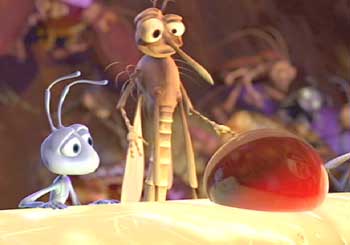
Disgusting


Saturday, October 19, 2013

therefore aliens


this is a meme

    Aliens. They represent the unknown, foreign powers, whatever. The best example of fear of the unknown is ‘religion’. Very religious people hasten to fill the void of the unknown with beliefs. And that’s cool. But I imagine part of their conviction comes from wanting to be sure of something. Aliens – from somewhere we know nothing about, who do things we know nothing about, and could or could not exist for all we know… a huge void to fill.


this is Paul
   In literature; they are often presented as evil corrupting forces. We have our typical come away with me I’m gonna abduct you and probe you and other awful things. (Scary stuff.) However one of my favorite raunchy movies: Paul; is about a good alien –who is being hunted down by the CIA. Paul is a cool dude –er, alien. He’s from another planet (obviously), and has been trapped in some CIA base making powerful friends and enemies. He meets our main characters while they are on an alien sightseeing tour. So I guess they get lucky. He meets them and freaks them out totally but eventually they become friends. So, relating back to my idea; he is mysterious, weird, disturbing looking, and he represents everything humans fear. We even address the whole religion thing when we meet a character played by Kristen Wigg named Ruth. Ruth lives in a trailer park and is a Christian fundamentalist. She is totally convinced that there is a God. Paul says; 'sorry, nope'. He’s messing with her convictions see? Basic human fear right there –doubt. He’s making her question what she has known for sure all her life. The funny thing is this movie is set up perfectly to prove my point. The basic structure of all of our main heroes is they meet Paul, freak out, but then he does this mind meld thing on them. He touches their foreheads and “copies all his knowledge and experiences into their mind.” After this they like Paul. Because they KNOW him. They UNDERSTAND him. He no longer represents a huge void to fill with explanations. So along with being a ridiculously entertaining movie the movie Paul helps me explain why we as a society fear aliens.               
    Now I know the example given to us as a class was foreign powers. That as a society we fear the foreign. And aliens represent that. And my idea is similar- you could argue foreign things are ‘unknown’. But do we really fear foreign countries? Or do we fear what we do not know about them? I’m not trying to prove you wrong here- but I have to get you back for that eye roll comment Mr. Lindsey!  I think that we don’t fear foreign countries. At least not today. Look at America – we love foreign countries! We’re practically a foreign country ourselves, American has become such a huge blanket for a bunch of different cultures. However we do fear change, racism is real and it comes from fear. The fear that things that we are so used to will change and a lot of the blame gets put on immigration or whatever. Wow I’ve gone off on a tangent. I better wrap this up. So basically – I don't know; therefore aliens. 
this is an adorable breadcat


Thursday, August 22, 2013

Creepy Martyr Behavior


Chapter 21: Marked For Greatness

               In this chapter Foster suggests that if a character has a scar, or a physical disability, it’s always for a reason. This idea I can totally get behind. As he points out, no one would put their character in say, a wheelchair for no reason, because this gives your character immediate depth and a series of choices. Are they bitter? Do they see every day as a gift? You cannot just have an ordinary character with a disability, because the disability will always shape them in some way. Even if they do not get something out of their disability the characters around them can either pity them to a point of frustration or simply ignore them to the point of neglect. It’s impossible for the disability not to influence the story, no matter how minuscule.

Overall it can work two ways, the disability can reflect something about the insides of the character, maybe something blatant or way deep down. Or the physical can be the opposite of the character, turning him into a martyr. Quasimodo is the bell-ringer of Notre Dame and rarely ventures outside the Cathedral since people despise and shun him for his appearance. We pity him, we feel compassion for this unlucky hero, so pure and in love with Esmeralda on the inside and so twisted and deformed on the outside. SIDE NOTE Did you know that “it is revealed in the story that the baby Quasimodo was left by the Gypsies in place of Esmeralda, whom they abducted”?! Because, I sure didn’t know that. END SIDE NOTE  Eventually he completely overcomes his shut-in behavior when Esmeralda is killed and he leaves his sanctuary of the tower opening himself up to ridicule and hatred (which happened each time he saved her as well) to go and die by her corpse. Creepy, but definitely martyr behavior. None of this would have happened if he was a “normal” young man, especially assuming that the gypsies wouldn’t have left him in place of Esmeralda if he hadn't had disabilities.

            In House of the Scorpion young Matt is a clone. He is branded as “Property of The Alacrán Estate” on the bottom of his foot. This is inevitably his mark for greatness, and it is the basis of the whole book. If Matt wasn’t a clone he wouldn’t face the (many) problems he does. The mark itself comes in to play specifically in two instances:

  1. The Alacrán family treats Matt kindly after he is brought into the house wounded until Mr. Alacrán, El Patron’s great-grandson, recognizes him as a clone as soon as they see the branding and reduce his life to a living hell, causing trails that shape his moral fiber.
  2. The “Lost Boys” he makes friends with later in the book (after many obstacles) lose faith in him after they see the tattoo, as clones are considered “zombies”, giving him the mission of earning their trust back and strengthening his relationship with them.  
These shape Matt’s adventure and his character. Without the brand he would not be recognized as a clone in these two situations therefore leading a less exciting life (and basically no book).

            Lady Macbeth marks herself (through insanity) when she believes she cannot wash the invisible bloodstains off of her hands. Inevitably this marking leads Lady Macbeth to kill herself, throwing her husband into despair. Thus influencing the ending of the play Macbeth, all because of a mark, which she has imagined but reflects her inner turmoil.

                  In the end of the chapter, Foster asks us to go find out what Harry Potter's scar meant and as a Harry Potter fan I believe the scar is a token of his mother's love; and of his tie to Voldemort. The scar through hurting him helps him realize danger, thereby affecting his character marking him so visibly as someone special. (Not to mention it’s basically a horcrux so that’s really important but we don’t learn that until the last book so…)


BLARGH I SAY


Chapter 12: Is that a symbol?


              Well of course it is says Foster. Great. I am not one who enjoys generalities. I like specifics, and being precise. Either you're right or you're wrong, and I hate being wrong. In the world Foster proposes nobody is wrong, but by default nobody is exactly right either. He claims the symbols are open to interpretation, that whatever a symbol means to an individual is right. BLARGH I SAY.

I like my symbols categorized. I understand the need to be unique, and to let everyone have their own opinion, but in this case I can get something totally different from the text then the person whose opinion matters the most on these things – the person giving me a grade and determining part of my future. So this frustrates me a little. One can find a multitude of charts on the meanings of symbols, and typically what the chart says; rain = rebirth, spring = new life, white = pure, is generally true. But now Foster is saying I could be in a lit class somewhere and say, oh yes this white flag in this story is signifying that the enemy is NOT giving up, they are saying, “come at me bro” because to them white is the void and they are daring their opponents to run into it. And this could be correct? When white is supposed to mean surrender? I haven’t read Animal Farm but if it’s not super open to interpretation I think maybe I should. Perhaps I will always prefer allegory over symbolism. No I definitely will, but this chapter was about symbolism so back to that.


I can see symbolism’s advantages. It lets each person imprint a little bit of themselves into the story, making it relevant to them. The white flag that’s so easy to use as an example is a good example again; in America we typically put our heroes, our virgins, in white whether on paper or screen, and our villains in red (or black -just go with it). However in Asia heroes often wear red; it’s the color of bravery. So this is eternally open to interpretation, because I guess no one is wrong, and again no one is right. (I hate that.) One could look at symbols from any angle as symbols are theoretically a circle. Whichever way you look at it, it’s still a circle, but each angle gives you a different perspective depending on your or the circle’s surroundings.


Now I suppose you want specific examples of symbols; well you have your classic “undisputables” like Holden’s red hat in Catcher in the Rye symbolizing protection, or beans in The Bean Trees representing a chance for growth, new life. These are used time and time again. What Foster says though is I could look at them in a totally different light, say the beans represent hmm… abandonment because they are plucked or dropped from the tree (essentially their mother) and therefore they still represent Turtle, as she also dealt with abandonment. So am I still right? Even though I disagree with scholars and sparknotes about the symbolism of the bean? Maybe if I always get to be right, open interpretation isn’t so bad after all.  

Because eels scare me

Chapter Five: Where Have I Seen Her Before? 

In this chapter, Foster states that no work of literature is original. Each subject is based on another subject and so on. I suppose this is true. Though I could list several books I have read that I find no resemblance in any classic or other works of literature, it is not a stretch to believe that the similarities are sitting trapped in some book I have yet to lay eyes on. As Foster states there are numerous examples for “stolen” ideas. She’s The Man (starring freshly crazy Amanda Bynes) is a direct nod at Shakespeare’s Twelfth Night. It’s blatant, her name is Viola and her brother’s is Sebastian, she pretends to be him. It’s not exactly the same, she isn’t lost at sea, she doesn’t fear for her life, she knows where her brother is, but at the root of the story the most important idea is still there. She falls for a guy, while she’s pretending to be a guy herself. (And hilarity ensues.) Although this isn’t just referencing a Shakespearian story or borrowing pieces, it is clearly based on it. It is the use of an old idea made new. We saw Viola in the 1600s and then we saw her anew in 2006:


Shakespeare’s work and ideas are found in numerous stories today, although many of “his” ideas were originally in Greek Classics or based on historic events. Mean Girls has an overt reference comparing Regina George to Julius Caesar, and as Foster points out the references flesh out the characters without the writer having to do much work. With all of our built up emotions and understanding of the referenced characters we assign traits to the new character without the author having to subtly assign them.


I like the idea on a basic level. Even Foster thinks there is no harm done whether one sees the reference or not. On one hand, either consciously or subconsciously, the reader experiences greater insight into the text. On the other, they continue to read on, oblivious to deeper meaning. No harm no foul, right? I don’t know about that. The idea that no idea is ever really original is upsetting. Who’s to say that just because one thing resembles another, it is directly based on it? The idea of synchronicity has always intrigued me. I know it’s not really relevant to this chapter, but who’s to say that two writers couldn’t come up with an idea at the same time; one just took a little longer to develop his/her writing? Maybe the writer wasn't influenced by anything except their own neurons and synapses.


I’d like to hold onto my idealistic fantasy that literature, as Foster suggests, is not really a bucket of eels at all (mainly because eels scare me). He believes that each work or eel as you will, is now in the great barrel of the public eye and that whether you like it or not, the eel has wormed its way into one's psyche influencing everything one does or more specifically, writes. I understand why he believes this. Looking around each thought I have is almost never my own, it’s been formed by the things I have heard and seen. I am much less likely to think of something original then I am to remember a movie quote or the plot of some funny commercial. And yet… part of me wants everyone to have a blank page in front of them, let a little of their own out, and not have someone pointing to a previous canvas or book comparing, crediting the first for influencing the new, when the first may deserve no credit at all.


SIDE NOTE


I realize this post is a little lacking in comparisons and I apologize. My summer brain is still in overdrive and this is why I can only think of chick flicks at the moment. I’m working on getting my school brain back. When your brain is a mush it is hard to hunt for the theoretical mushrooms Foster mentions at the end of this chapter but I’m working on it.